Executive technical advisory and continuity-risk services by Robert McKean.
Global Active helps organizations handle high-stakes technical transitions
with executive judgment, hands-on systems experience, and source-grounded
analysis.
Founder Background: Executive engineering accountability,
Microsoft Surface camera platform ownership, formal Machine
Learning/AI training, and current hands-on AI systems work.
Primary Service: Global Active's Key-Person Risk Brief. The
technical work below provides supporting evidence of the systems,
retrieval, and AI execution behind the practice.
Primary Service
Global Active
Key-Person Risk Brief
A source-cited brief of the critical knowledge, open commitments, and
continuity risks left behind when a key person leaves the company.
A 48-to-72-hour white-glove engagement that turns a key person's work
records into an executive brief, a verified evidence trail, and a secure
workspace your team can query for ongoing continuity decisions.
Built for C-Suite, technical executives, general counsel, founders, and boards facing a key-person transition.
Deliverables Executive brief, verified evidence trail with coverage notes and documented limits, secure query user interface, and deletion confirmation at closeout.
Selected Technical Work
Brain Dump
A retrieval-augmented generation (RAG) system that turns organizational records into source-linked answers.
What it is: Brain Dump is an AI memory system built over
a defined corpus of organizational records: email, Slack, meeting notes,
attachments, project documents, tickets, LLM chat history, decisions, and
other source artifacts. When asked a question, it retrieves the relevant
material, synthesizes an answer, and preserves the evidence trail back to
the records behind that answer.
Why it matters: The trust problem with LLMs is not just
that they can hallucinate. It is that they can produce confident,
polished answers with no reliable way to verify where the answer came
from, whether it is supported, or what source material was used. Brain
Dump is built to address that specific failure mode. It grounds each
response in retrieved organizational records and preserves the source
trail behind the answer. For further confidence, Brain Dump provides
links to the exact words, data, and artifacts that were used to generate
the answers.
Brain Dump - SynthetiCorp Demo
SynthetiCorp is a fictional corporate project built to demonstrate Brain
Dump in public. The demo corpus contains synthetic project records,
communications, decisions, and supporting artifacts created around a
simulated product initiative: a team working through technical
architecture, analytics design, customer-impacting bugs, implementation
tradeoffs, handoffs, and launch-readiness questions.
The same approach can be applied to real organizational records where
teams need reliable answers grounded in the source material behind their
work.
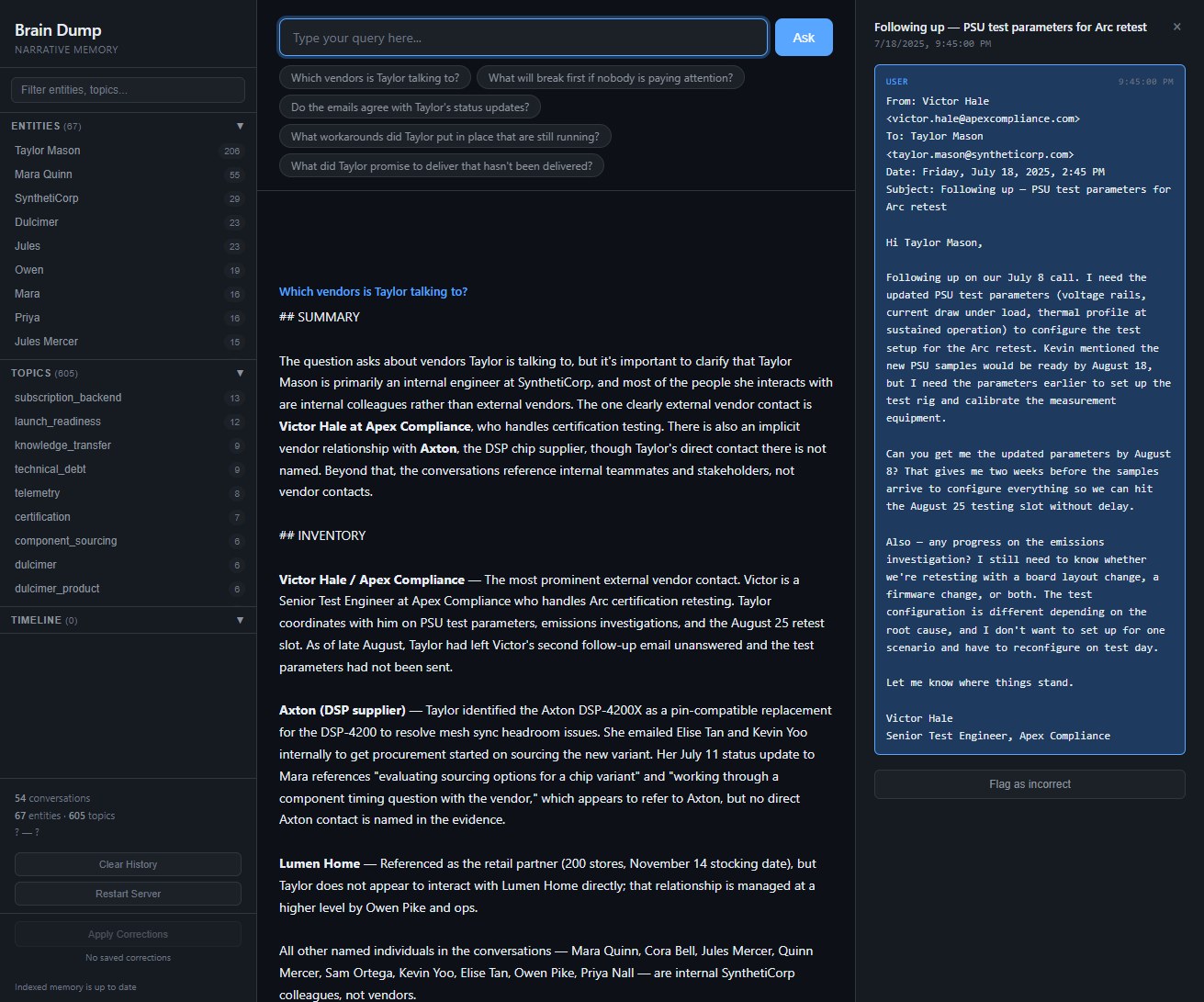
Using the Live Demo,
users can query the database generated from the synthetic SynthetiCorp
data by typing questions about the project. Each answer includes
clickable references to the exact source records used to generate the
response, so users can move between the summary and the underlying
data.
The public demo exposes the synthetic SynthetiCorp corpus through a
query interface with example questions, entity and topic indexes, and
source-grounded answers after a query is submitted.
End-to-end ML pipeline from raw drum audio to structured MIDI.
What it is: A complete machine-learning pipeline from raw
drum audio to structured MIDI (Musical Instrument Digital Interface).
Uses a 9.5-hour curated training set, a PyTorch and nnAudio model with a
trainable STFT front end, and a custom 1D convolutional encoder-decoder
for multi-class drum event detection and velocity prediction. Achieves
3.125ms timing resolution, engineered to fit within an 8 GB consumer GPU.
Why it matters: Drums-to-MIDI addresses a real-world
challenge by implementing a production-style AI workflow: data
engineering, model building, architecture, training, evaluation, and
iteration. As a portfolio artifact it offers concrete evidence of
hands-on ML execution. Note: The project was built with Python and
PyTorch prior to the emergence of code-generating LLMs.
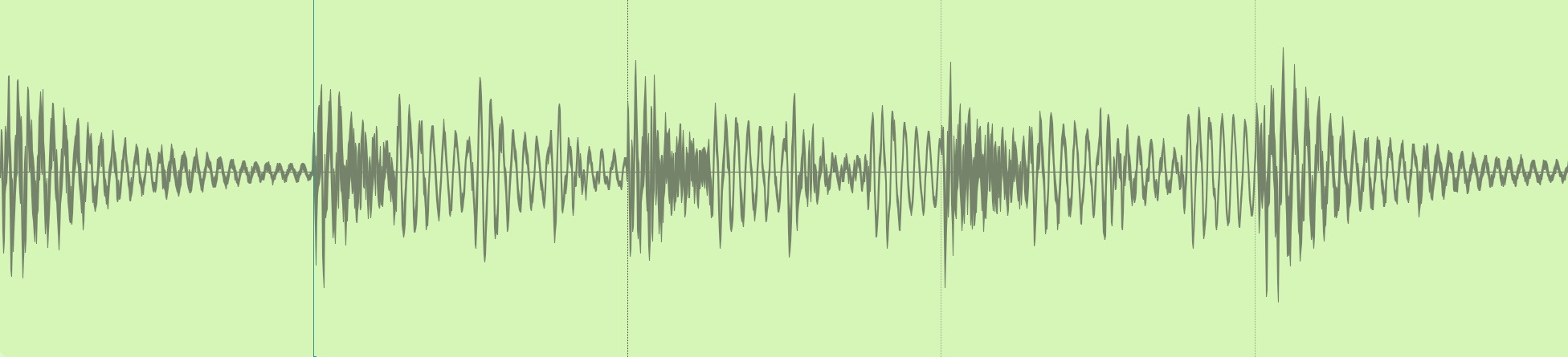
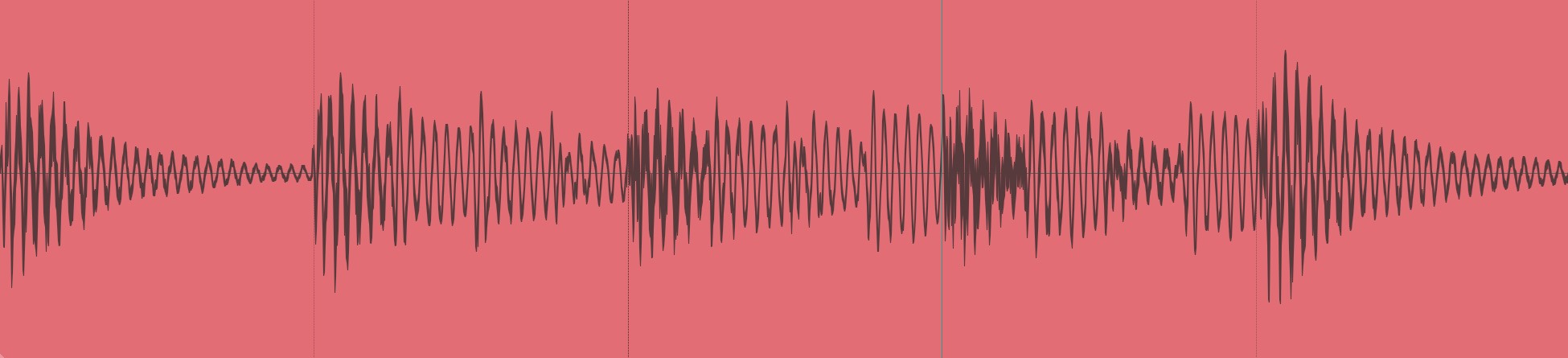
Input audio (ground-truth) compared to audio generated by the predicted
MIDI output for the same 2.5-second slice. Across 29 matched drum hits,
the maximum timing variation is 6 MIDI ticks, or 3.125 ms at 120 BPM
and 960 ticks per beat. Timing accuracy was limited by the 8GB of GPU
memory available. The slight audible difference is primarily due to
minor velocity differences, especially snare and ride cymbal levels.
Summary: Three decades of executive and engineering
leadership spanning LINE 6, MUSIC Tribe (Behringer), HARMAN
Professional, TP-LINK, Microsoft Surface, and independent advisory work.
Coursera
specializations in Machine Learning (Andrew Ng), Deep Learning,
TensorFlow, and Data Science. BS Electrical Engineering. Lived and
worked in China for 7 years.
Why it matters: The technical work above is backed
by stop-ship authority over a $1B product division, direct accountability
for global engineering organizations of 60 to 200+ people, and repeated
production-readiness reviews at the executive table.CVLinkedIn